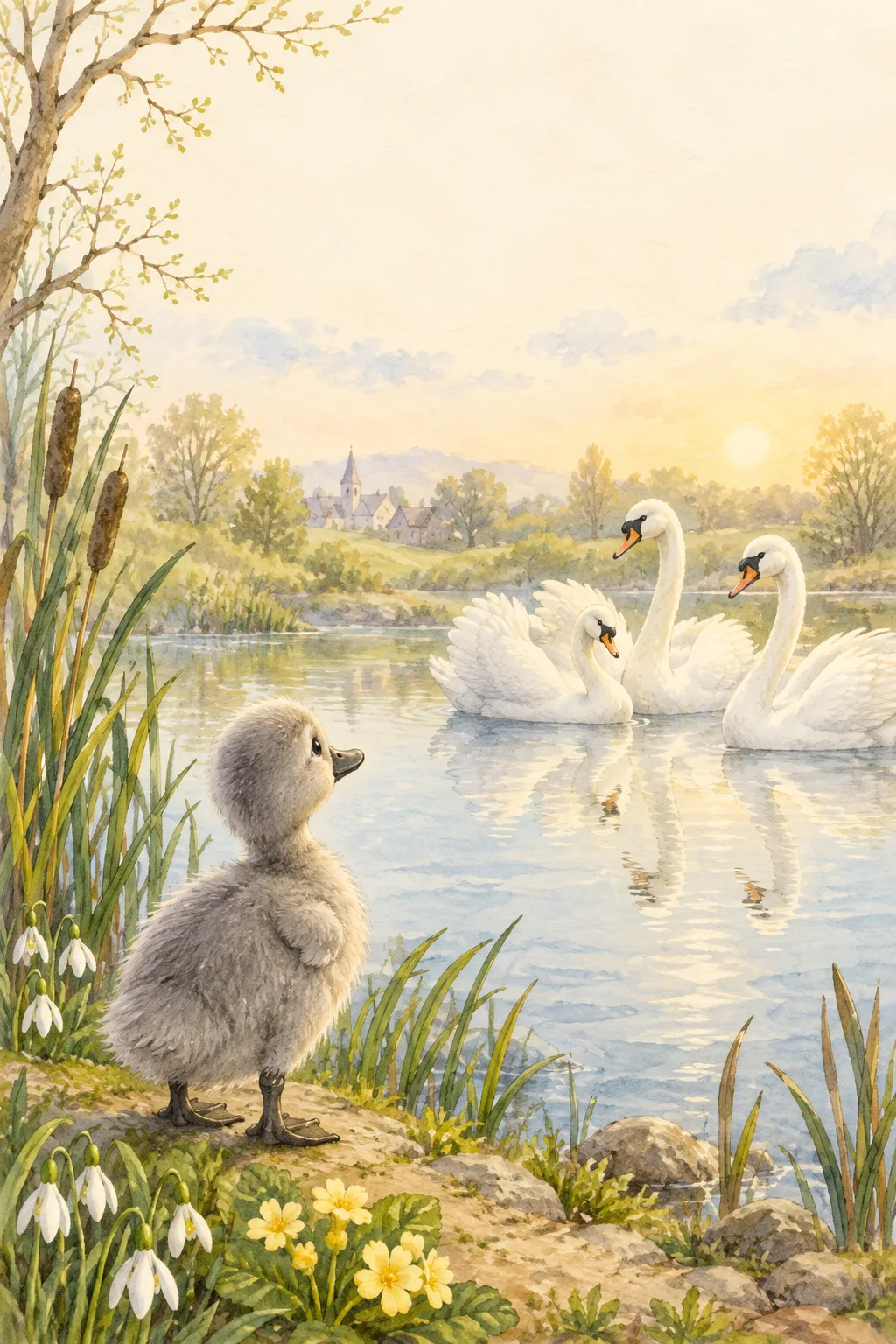
A gray young bird hatched in a duck's nest. The other ducklings teased him because he looked different. He left the farm and found a peaceful lake. Summer turned to winter. He kept going, even when he felt lonely. When spring came, he saw elegant swans on the water. He lowered his head and saw his reflection beside them. He had grown into a swan too. The swans invited him to swim with them. The bird's worth had never depended on looking like the ducklings.
A First Stories tale
The Ugly Duckling
Slide left for a simpler telling and right for more detail. Your choice carries to the next story.
Open this version in the audiobook shelfOne young bird looked different from the ducklings around him. Some birds were unkind, so he went looking for a quieter pond. Seasons passed. He grew bigger and learned to fly. One spring he saw his reflection: he was a beautiful swan. He found other swans who welcomed him. He had always belonged somewhere.
A gray young bird hatched in a duck's nest. The other ducklings teased him because he looked different. He left the farm and found a peaceful lake. Summer turned to winter. He kept going, even when he felt lonely. When spring came, he saw elegant swans on the water. He lowered his head and saw his reflection beside them. He had grown into a swan too. The swans invited him to swim with them. The bird's worth had never depended on looking like the ducklings.
The last egg in a duck's nest took longer to hatch. Out came a large gray bird unlike the yellow ducklings beside him. The farm birds stared and some made unkind remarks. The little bird tried to fit in, but he felt more alone each day. At last he left and found a quiet lake.
Autumn winds shook the reeds. Through the winter, the young bird took shelter wherever he could. When spring warmed the lake, a group of white swans landed nearby. He admired their graceful wings. Looking into the clear water, he discovered that his own wings and neck had changed. He was a swan. The others welcomed him, and he joined them on the water. Remembering the farm, he wished its birds had been kinder. He had not needed to become valuable; he had been valuable all along.
At the edge of a farm pond, a duck watched her eggs hatch. The last egg opened late, revealing a gray bird larger than the others. The mother cared for him, but the farmyard birds were quick to laugh at his awkward walk and unfamiliar shape. He began to believe their judgment. Leaving the farm seemed easier than hearing it every day.
He traveled between ponds and marshes. He met birds who ignored him and a few who offered shelter. Winter was difficult; ice covered the water, and he had to keep searching for food. When spring arrived, he saw swans gliding across a lake. He thought they were the most beautiful birds he had ever seen.
As he moved toward them, he looked down into the water. His reflection showed a long neck and white feathers. He, too, was a swan. The others greeted him without surprise. The young bird felt joy, but he also remembered how deeply the teasing had hurt. Looking different from a group had never made him lesser. It had only meant that the group had failed to understand him.
The final egg in the nest was unusually large. When it opened, the duck found a gray hatchling who did not resemble her other young. She protected him as best she could, but the farmyard was full of sharp opinions. Birds who knew nothing about him called him clumsy or ugly simply because he looked unfamiliar. He tried to copy the ducklings, yet his growing wings and long neck made him stand apart.
Eventually he left. Across one season and then another, he found temporary shelter among reeds, crossed frozen ground, and learned that kindness could come from unexpected places. He also learned that loneliness does not make unkind words true. Still, the winter seemed very long.
In spring, swans returned to the lake. He watched them with a mixture of admiration and fear, certain they would turn him away. Instead, when he approached, they welcomed him. A glance at the water showed why they recognized him: his gray down had given way to white feathers, and he had become a swan.
The discovery did not erase the hard months. It changed how he understood them. The farmyard had measured him against the wrong expectation, and he had nearly accepted its mistake as a fact about himself. Swimming beside the other swans, he knew he had deserved gentleness from the beginning.
Inspired by Fairy Tales of Hans Christian Andersen. This text is a new adaptation.