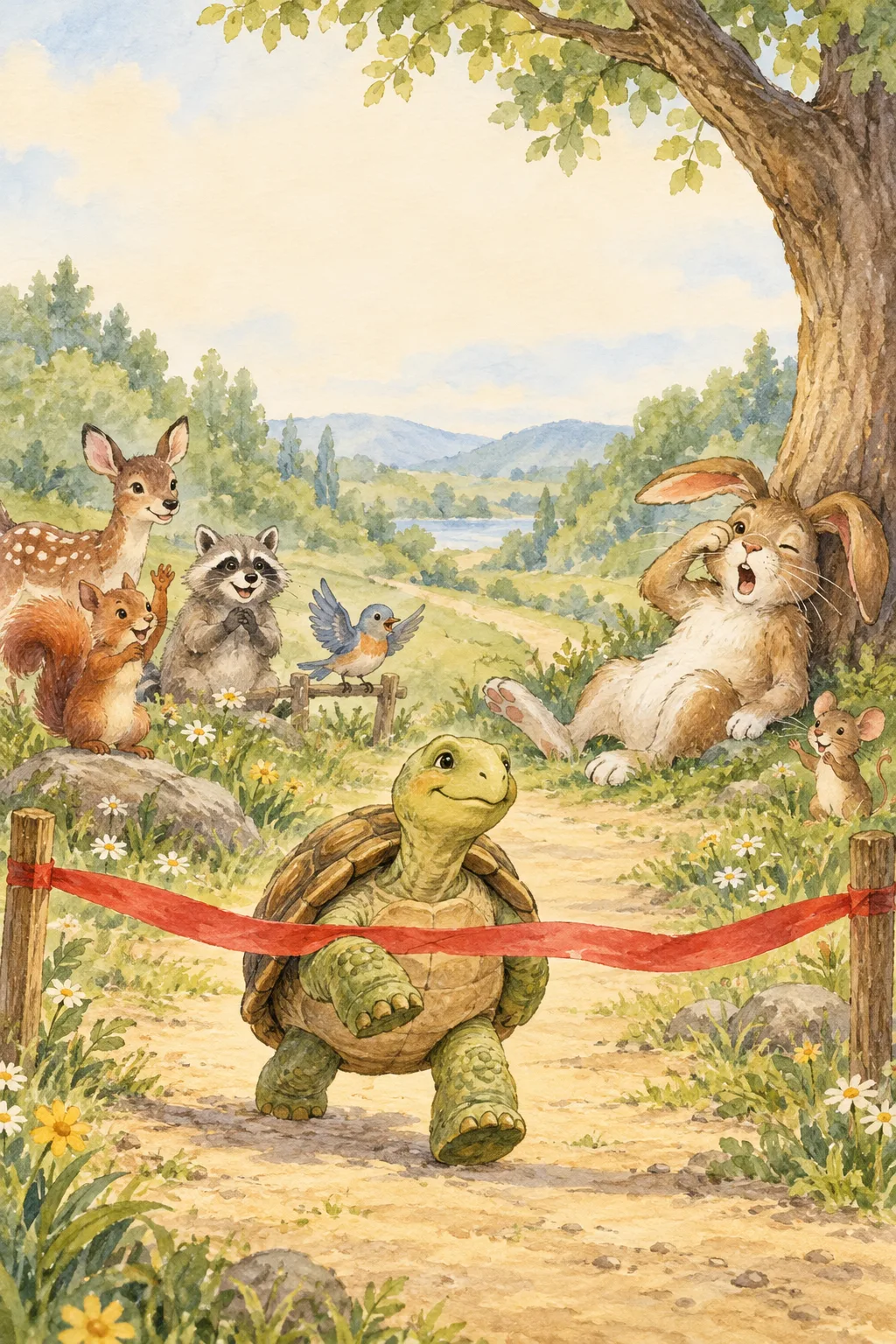
Hare bragged that nobody could beat him in a race. Tortoise said she would try. When the race began, Hare sped far ahead. He was so sure he would win that he lay down for a nap. Tortoise kept walking, one step after another. She passed the sleeping Hare and crossed the finish line. Hare woke and ran as fast as he could, but the race was over. He congratulated Tortoise and promised not to laugh at her pace again.
A First Stories tale
The Tortoise and the Hare
Slide left for a simpler telling and right for more detail. Your choice carries to the next story.
Open this version in the audiobook shelfHare loved to run fast. Tortoise moved slowly but liked to keep going. They raced to a tree. Hare stopped for a nap. Tortoise walked and walked until she reached the tree. Hare woke too late. He said, “Well done!” They both learned that steady steps can take you far.
Hare bragged that nobody could beat him in a race. Tortoise said she would try. When the race began, Hare sped far ahead. He was so sure he would win that he lay down for a nap. Tortoise kept walking, one step after another. She passed the sleeping Hare and crossed the finish line. Hare woke and ran as fast as he could, but the race was over. He congratulated Tortoise and promised not to laugh at her pace again.
Hare was proud of his speed. He often made jokes about Tortoise, who moved slowly. One day Tortoise challenged him to a race. The other animals marked a starting line and a finish line beneath a tall oak. At the signal, Hare dashed ahead. He looked back and could barely see Tortoise. Certain of victory, he rested in the shade and fell asleep.
Tortoise did not hurry. She simply kept moving toward the oak, step by step, even when the path rose uphill. She passed Hare while he slept and reached the finish line first. Hare woke, sprinted, and found everyone cheering for Tortoise. He was surprised and embarrassed, but he shook her hand. Tortoise had not become faster than Hare. She had finished what she started, while Hare had stopped paying attention.
Hare's quick feet had won him many races, and he talked about them so often that the other animals grew tired of hearing it. He laughed at Tortoise for moving slowly. Tortoise suggested they race to the old oak. Hare agreed because the result seemed obvious to him.
At the starting call, Hare shot down the path. Tortoise set off at her usual pace. Hare reached a patch of shade with plenty of time to spare. He decided to rest, expecting to wake long before Tortoise arrived. The breeze was warm, and soon he slept.
Tortoise passed the shaded spot without waking him. Her legs were tired, but she kept to the path, one steady step after another. When Hare finally opened his eyes, he saw her near the oak. He ran, but she crossed the finish line first. Hare congratulated her, then admitted that he had mistaken an advantage for a guarantee. Tortoise smiled. Her plan had never been to outrun him in a sprint; it had been to complete the race.
Hare was undeniably fast, but he had begun to confuse speed with superiority. He spoke as if Tortoise's slower movement made her efforts unimportant. Tortoise, tired of the teasing, challenged him to a race. The woodland animals chose a route to the old oak and agreed to watch both racers fairly.
Hare raced away at once. Tortoise kept a pace she knew she could maintain. Halfway down the course, Hare looked back and saw no sign of her. He settled beneath a tree, imagining how impressive his last-minute sprint would look. The warm afternoon turned his short rest into a deep sleep.
Tortoise passed quietly. The path climbed over roots and dipped through soft earth, but she continued. She was not certain she would win; she was certain she would reach the oak. As she crossed the finish line, Hare woke and sprinted toward it. He arrived moments too late.
The crowd cheered for Tortoise. Hare felt embarrassed, but he did not blame the weather or the rules. He had chosen to stop. He congratulated her and listened when she said that a steady pace was its own strength. The race had not proved that speed was bad. It had shown that talent is most useful when joined with attention and respect.
Inspired by Aesop's Fables. This text is a new adaptation.