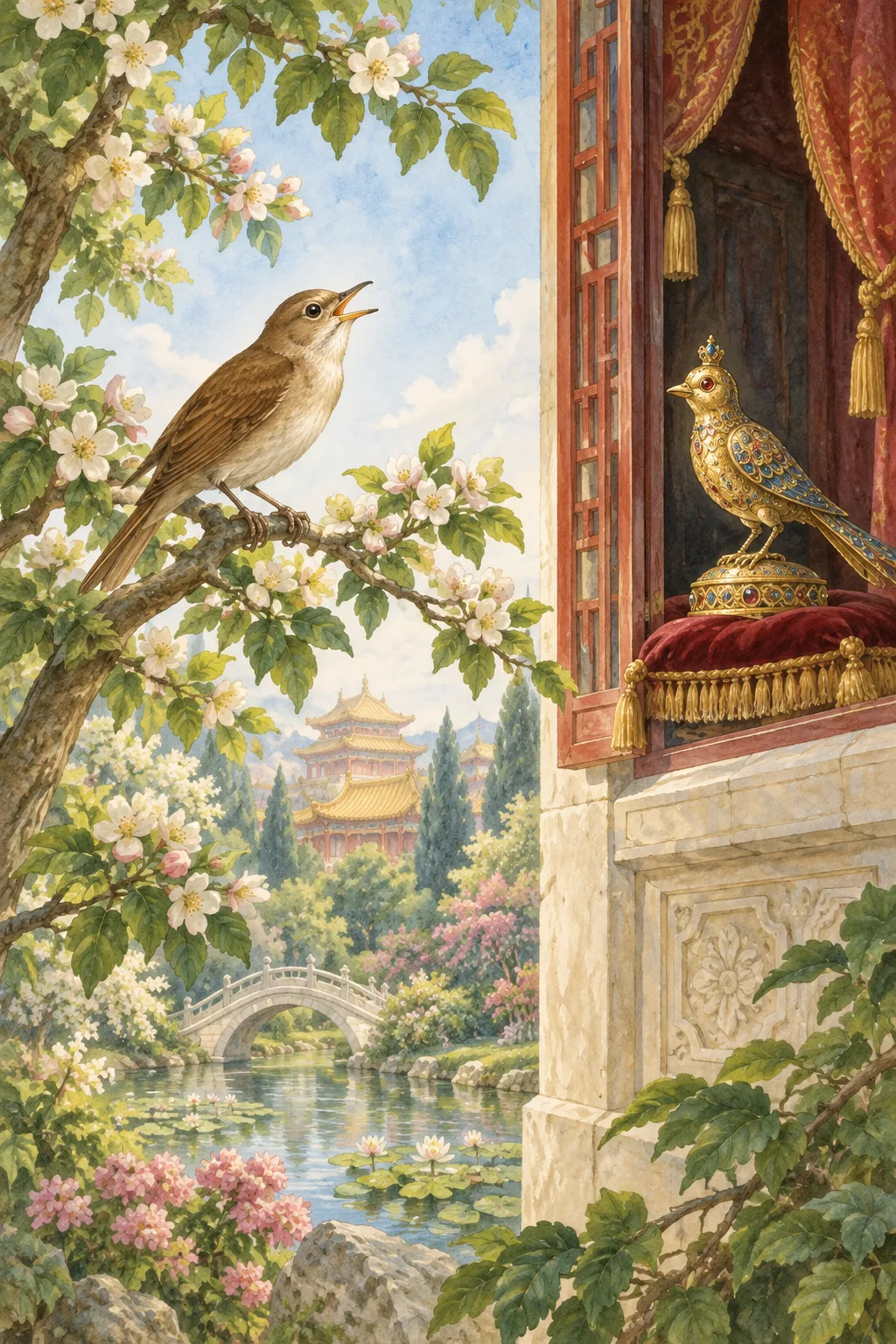
The emperor heard a nightingale singing outside his palace. Its song made him feel peaceful. He invited the bird to visit. Later he received a jeweled toy bird. It sang the same tune every time, and everyone watched it sparkle. The nightingale flew back to the trees. One day the toy stopped working. The emperor missed music and felt alone. At dusk the real nightingale returned and sang by his window. The emperor thanked it and promised not to keep it in a cage. The bird visited whenever it wished.
A First Stories tale
The Nightingale
Slide left for a simpler telling and right for more detail. Your choice carries to the next story.
Open this version in the audiobook shelfA nightingale sang in the garden. The emperor loved its song. Someone gave him a shiny toy bird that could sing one tune. Soon the toy stopped. The emperor felt lonely. The real nightingale came back to the window and sang a fresh song. The emperor smiled. He left the window open so his friend could come and go.
The emperor heard a nightingale singing outside his palace. Its song made him feel peaceful. He invited the bird to visit. Later he received a jeweled toy bird. It sang the same tune every time, and everyone watched it sparkle. The nightingale flew back to the trees. One day the toy stopped working. The emperor missed music and felt alone. At dusk the real nightingale returned and sang by his window. The emperor thanked it and promised not to keep it in a cage. The bird visited whenever it wished.
Beyond the palace garden lived a nightingale whose singing could quiet a busy room. The emperor asked the gardeners to show him where it lived. When he heard its changing songs, he invited the small bird to visit the palace. It sang there for many evenings, always returning to the trees afterward.
Then a gift arrived: a jeweled bird wound with a key. It could sing one lovely tune. Courtiers praised its glitter and played it again and again. The real nightingale went back to the garden, where it could sing in its own way.
After many turns of the key, the toy's gears stopped. The palace grew quiet. The emperor realized he missed the unexpected notes of his old visitor. That evening the real nightingale came to the window. Its song was different from the last one, and that was what made it wonderful. The emperor listened without asking the bird to stay. He kept the window open, glad to welcome a friend rather than own a singer.
Travelers often praised the emperor's beautiful palace, but they remembered something else more clearly: the nightingale that sang in the woods beyond its walls. Its notes seemed to change with every breeze. Curious, the emperor asked a gardener to guide him to the bird. He listened beneath a tree and invited it to sing by his window whenever it wished.
Soon a magnificent gift arrived from another kingdom. It was a clockwork bird set with bright stones. With a turn of a key it played a perfect tune. The courtiers could predict every note, and they liked showing visitors how splendid it looked. They paid less attention to the living nightingale, which returned to the woods.
For months the toy sang at every feast. Then its gears wore down. A careful repair gave it only a few notes before it fell silent again. The emperor, who had been feeling unwell, missed the music that had once helped him rest. He also missed the freedom in the nightingale's song.
At dusk a familiar bird settled on the open windowsill. It sang softly, then boldly, until the emperor felt the day grow lighter. He thanked it. The toy was still beautiful, but he no longer expected it to replace a living creature. He asked the gardeners to care for the woods, and he left the window open for visits that could not be scheduled by a key.
Visitors to the emperor's palace admired its painted halls, yet their stories always returned to a song heard outside. A nightingale lived in the trees beyond the garden. Its music changed with the hour and the weather, so no two listeners remembered it in quite the same way. The emperor, surprised that he had never heard it, asked a gardener to take him into the woods.
He invited the bird to his window. For a while it came freely, singing on evenings when the palace was quiet. Then an ornate mechanical bird arrived as a diplomatic gift. Its feathers glittered with jewels. A key made it play a delicate melody that was exactly the same each time. Courtiers could arrange the toy at the center of a feast and count on it to perform. They began to call it better than the nightingale because it never wandered away.
The real bird returned to its trees. The emperor did not notice its absence at first. Months later the clockwork song faltered. A craftsperson explained that its gears had worn down and could be played only rarely. With the music gone, the palace felt strangely still. The emperor had also grown ill, and the stillness weighed on him.
One evening the nightingale appeared on his windowsill. It sang without a cue, first a quiet phrase, then a lively one. The emperor listened until he felt able to sleep. In the morning he asked the gardeners to protect the trees where it lived.
The toy remained on its velvet stand, an impressive piece of craft. But the emperor understood that a living voice could not be stored, wound up, or commanded. The nightingale continued to visit when it chose, and the palace learned to enjoy a song that belonged to the bird itself.
Inspired by The Nightingale by Hans Christian Andersen. This text is a new adaptation.